
Overview
Charger Access Groups introduce a new, flexible access control layer in eMabler that is independent of site hierarchy and electrical topology (DLM).
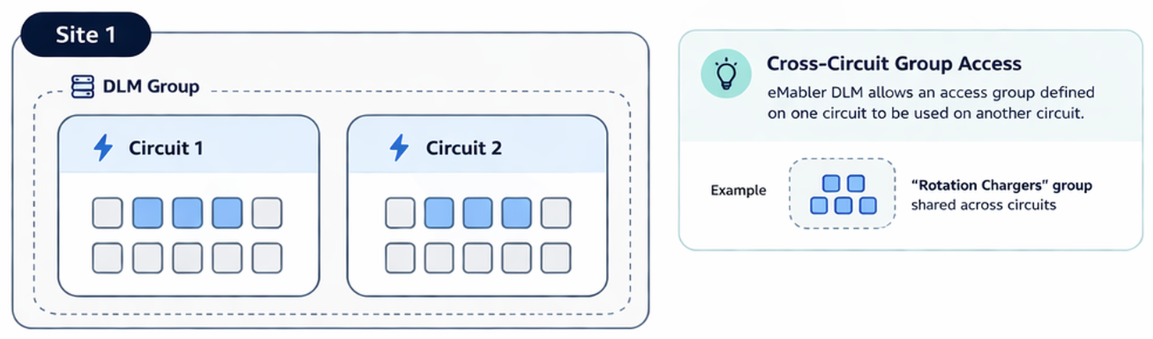
Today, access control is tightly coupled with site structure, which reflects physical infrastructure (circuits, load balancing). However, real-world access needs—such as parking ownership, shared chargers, or tenant-based access—do not align with this structure.
Charger Access Groups solve this by enabling logical grouping of chargers for access purposes, without impacting DLM or site configuration.
Problem Statement
The current access model forces customers into one of the following limitations:
-
Managing access groups outside of eMabler
-
Granting access at higher (parent) site levels, resulting in excessive permissions
-
Assigning access on a per-charger basis, which is manual and not scalable
This limitation becomes more evident when:
-
DLM requires sites to be modeled based on electrical circuits
-
Access needs are based on parking zones, ownership, or tenancy
Solution
Charger Access Groups provide a logical, decoupled access control mechanism that:
-
Groups chargers across sites and circuits
-
Enables fine-grained driver access control
-
Works alongside existing access methods without replacing them
Key Concept
A Charger Access Group is:
-
A logical collection of chargers
-
Independent of site/subsite hierarchy
-
Used exclusively for driver authorization
A charger can:
-
Belong to one site (for DLM purposes)
-
Belong to multiple access groups (for access control)
Access Model
Driver access is now determined by a combination of:
-
Site access (existing)
→ Access to all chargers within a site hierarchy -
Direct charger access (existing)
→ Access to specific chargers -
Charger access group access (new)
→ Access to all chargers within assigned groups
Effective Access
A driver’s access is the union of all three sources:
-
Site-based access
-
Direct charger assignments
-
Access group memberships
Access is evaluated dynamically at authorization time.
User Experience
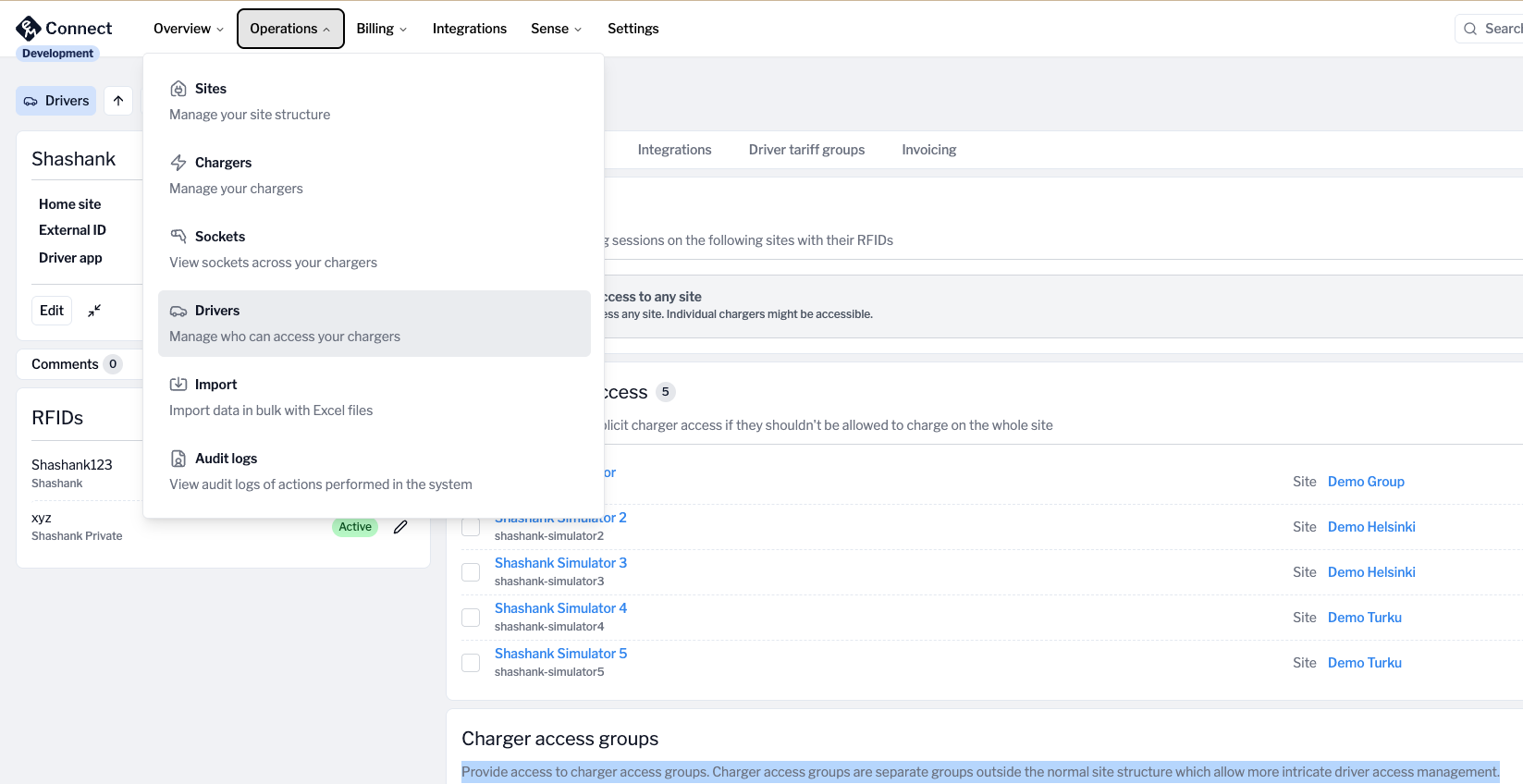
Driver Access Page
A new section, “Charger access groups”, is available in the driver access view.
This section:
-
Displays all access groups the driver belongs to
-
Allows assigning and removing group access
-
Is clearly separated from:
-
Site access
-
Direct charger access
-
This introduces a third, flexible layer of access control within the UI.
Managing Charger Access Groups
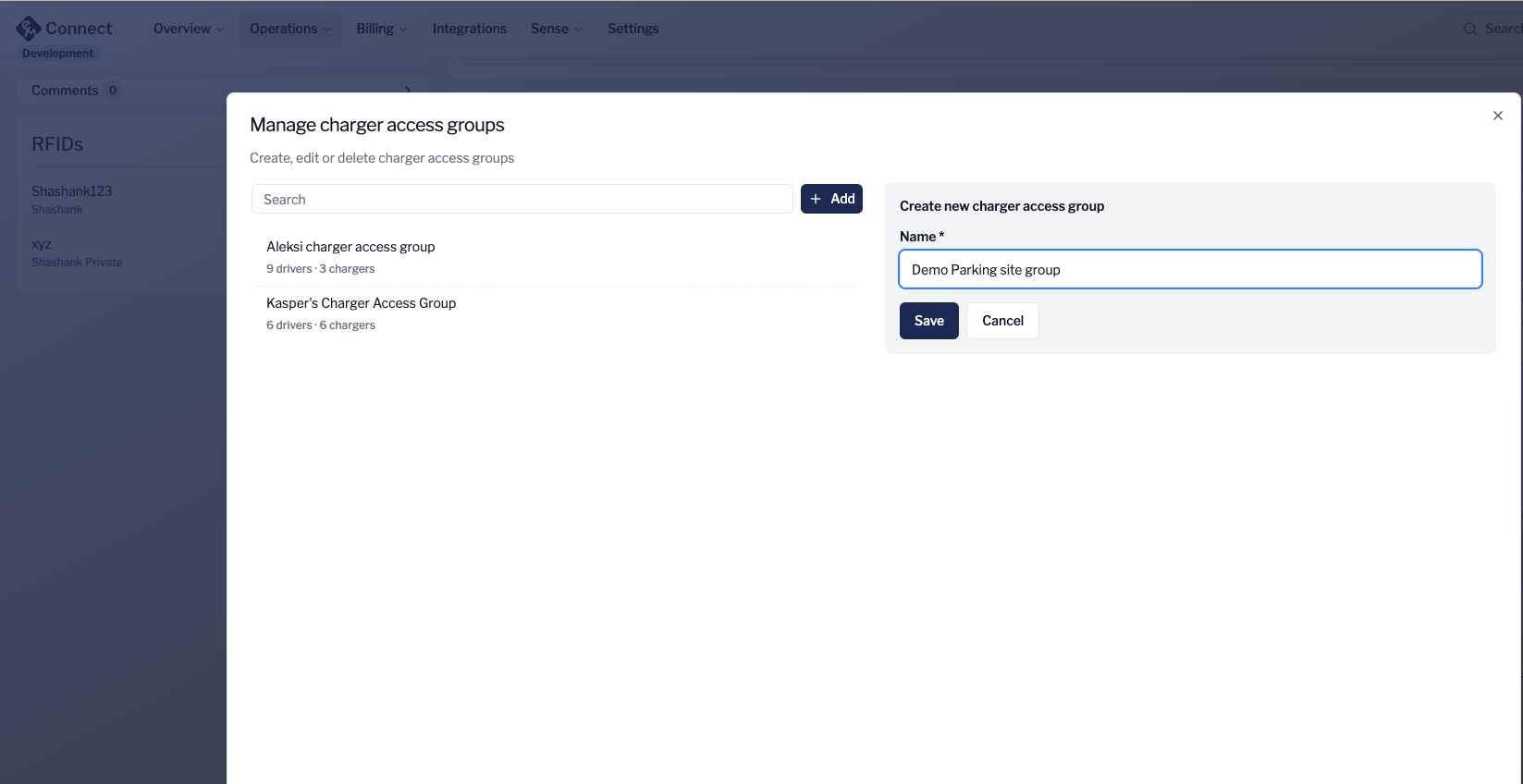
Accessible via:
Operations → Drivers → Charger Access Groups
This interface allows users to:
-
View all existing access groups
-
Search and filter groups
-
Create new groups
-
Edit existing groups
-
Delete groups
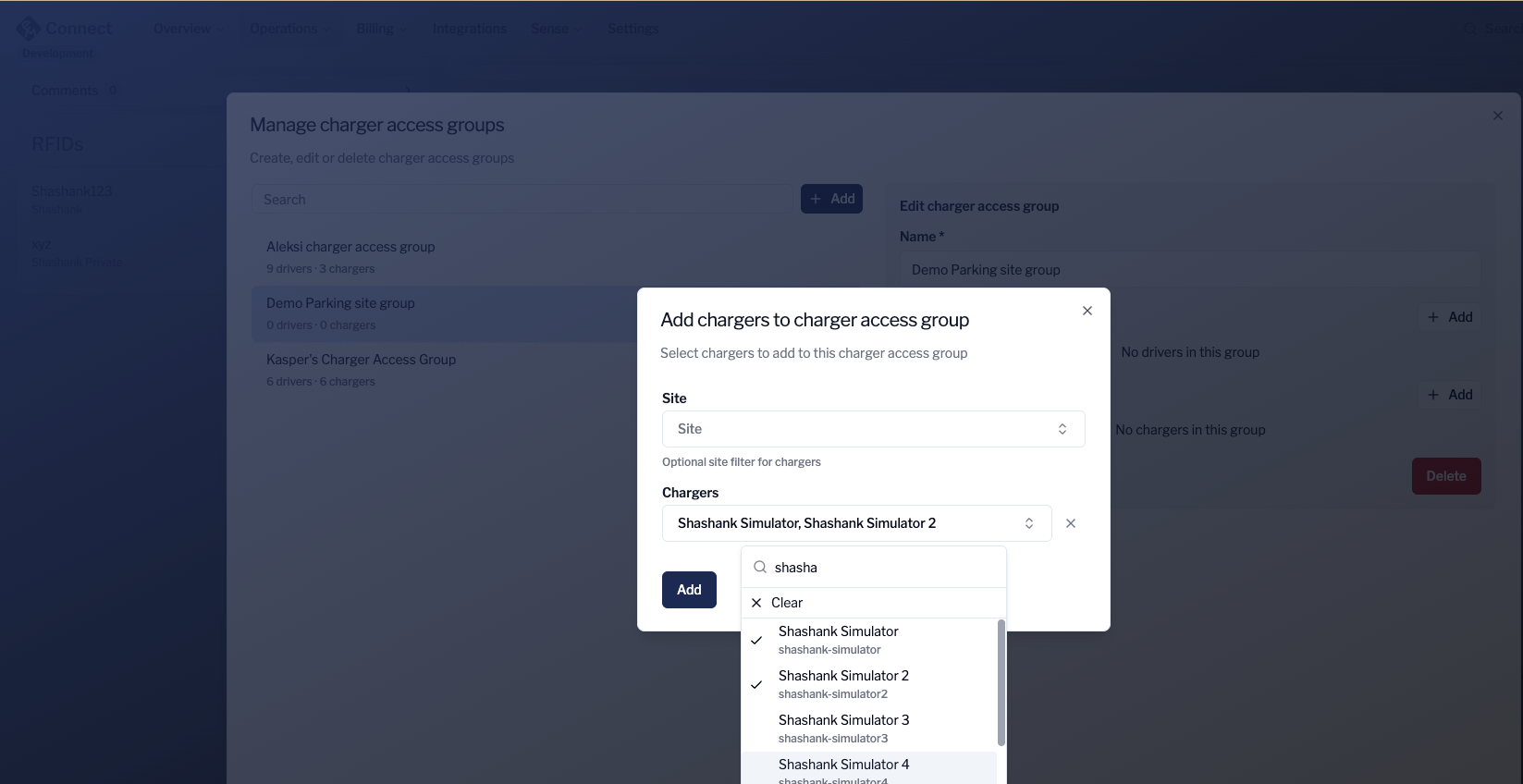
Creating and Editing Groups
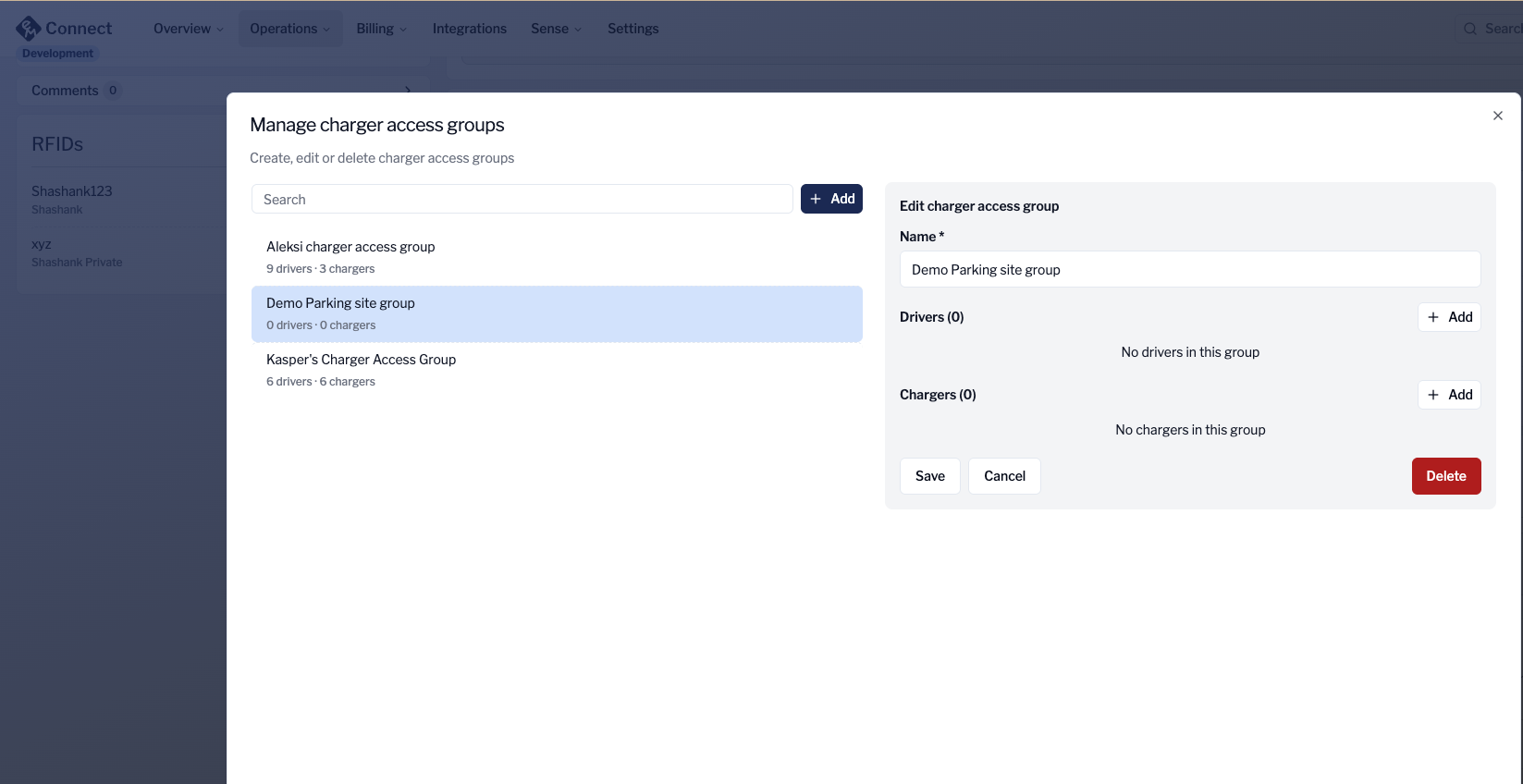
Each Charger Access Group contains:
-
Name
-
Assigned drivers
-
Assigned chargers
Users can:
-
Add or remove multiple drivers in bulk
-
Add or remove multiple chargers in bulk
-
Optionally filter chargers by site during selection
Supported Use Cases
1) Shared Charger Pools
In many environments, a subset of chargers is intended to be shared among multiple users, while others remain reserved.
Example:
-
A company has 20 chargers:
-
10 are assigned to specific employees (dedicated)
-
10 are shared among visitors or a rotating pool of users
-
With Charger Access Groups:
-
The shared chargers can be grouped into a “Shared Pool”
-
Multiple drivers can be granted access to this group
-
No need to assign access charger-by-charger
This simplifies management and ensures consistent access across all shared chargers.
2) Parking Zone-Based Access
Access control is often defined by physical parking zones, not electrical circuits.
Example:
-
A parking facility is divided into:
-
Zone A (reserved for tenants)
-
Zone B (public or guest parking)
-
-
Chargers in each zone may belong to different circuits (DLM groups)
With Charger Access Groups:
-
Chargers in each zone can be grouped logically (e.g., “Zone A Chargers”)
-
Access can be granted based on parking rights, not infrastructure
This aligns the system with how parking is actually allocated and used.
Benefits
For Customers
-
Fine-grained and flexible access control
-
Alignment with real-world parking and ownership models
-
Reduced need for external access management systems
For Platform
-
Improved scalability for enterprise customers (e.g., Aneo, Movel)
-
Cleaner architecture with clear separation of responsibilities
-
Foundation for future enhancements in access control