
Overview
eMabler Connect supports Plug & Charge (PnC) under ISO 15118: the driver plugs in and charging starts, with no app, RFID card or QR code. Connect manages the certificates on both sides of the handshake, so an operator can run PnC as a CPO (on its chargers), as a Mobility Operator (MO) (for its own app drivers), or as both.
PnC runs over OCPP 2.0.1 natively and over OCPP 1.6J via the OCA Plug & Charge extension (DataTransfer), and interoperates with the V2G PKI ecosystems (for example Hubject) that OEMs and other MOs use.
Two roles, one platform
|
|
CPO role |
MO role |
|---|---|---|
|
Who |
Operators running PnC-capable chargers |
Operators with a driver app and contracts |
|
What Connect manages |
Charger (SECC) certificates and trusted roots on each charger |
eMAIDs and contract certificates for app drivers |
|
Key identifiers |
Charge Point ID, SECC certificate |
PCID (from the vehicle), eMAID (issued by Connect) |
|
Outcome |
Chargers accept PnC from any trusted MO |
Your drivers get PnC on your network and in roaming |
|
Typical customer |
ABC, Aimo Park, Helen as network owners |
ABC, Helen with their own charging app |
CPO role: certificates on your chargers
Connect installs and keeps valid every certificate a charger needs to take part in PnC, with no site visit.
-
Enable PnC per charger in Connect, based on charger model and firmware capability (ISO 15118 support reported by the charger).
-
Install trusted roots: Connect pushes the V2G root and MO root certificates to the charger (
InstallCertificate), so it can trust the vehicle's contract certificate. -
Issue the charger certificate: the charger generates a key pair and sends a CSR (
SignCertificate); Connect has it signed by the CPO Sub-CA in the PKI and returns it (CertificateSigned). -
Monitor and renew: Connect tracks expiry per charger, triggers renewal before expiry (
TriggerMessage), and shows certificate status in the charger view. -
Revoke and clean up: remove or replace certificates (
DeleteCertificate,GetInstalledCertificateIds) when a charger is swapped, decommissioned or compromised.
What the operator sees in Connect: PnC status per charger, certificate chain and expiry, failed installs with the reason, and bulk actions across a site or charger group.
MO role: PnC contracts for your app drivers
Connect lets an operator with its own driver app act as a Mobility Operator: it turns a driver's vehicle into a PnC contract in a few taps.
-
Driver opts in from the app: the app asks for the vehicle's PCID (Provisioning Certificate ID, shown in the car's infotainment or OEM app) and links it to the driver's account.
-
Connect creates the eMAID: a unique contract ID in ISO 15118 / eMI3 format (for example
FI-XYZ-C12345678-9), using the operator's eMSP ID and a check digit. -
Connect requests the contract certificate from the PKI's Contract Certificate Pool (CCP), bound to the PCID and eMAID and signed under the MO Sub-CA.
-
The vehicle picks it up: the OEM backend retrieves the contract from the pool and installs it in the car. The driver sees status in the app (pending, active, failed).
-
Connect creates the token: the eMAID becomes an authorization token on the driver's contract, so sessions, tariffs and billing work the same as RFID.
-
Lifecycle: renew before expiry, suspend or revoke when the driver leaves or changes vehicle.
Supported via Connect APIs for white-label and customer-built apps, so the operator keeps its own brand and UX.
End-to-end flow
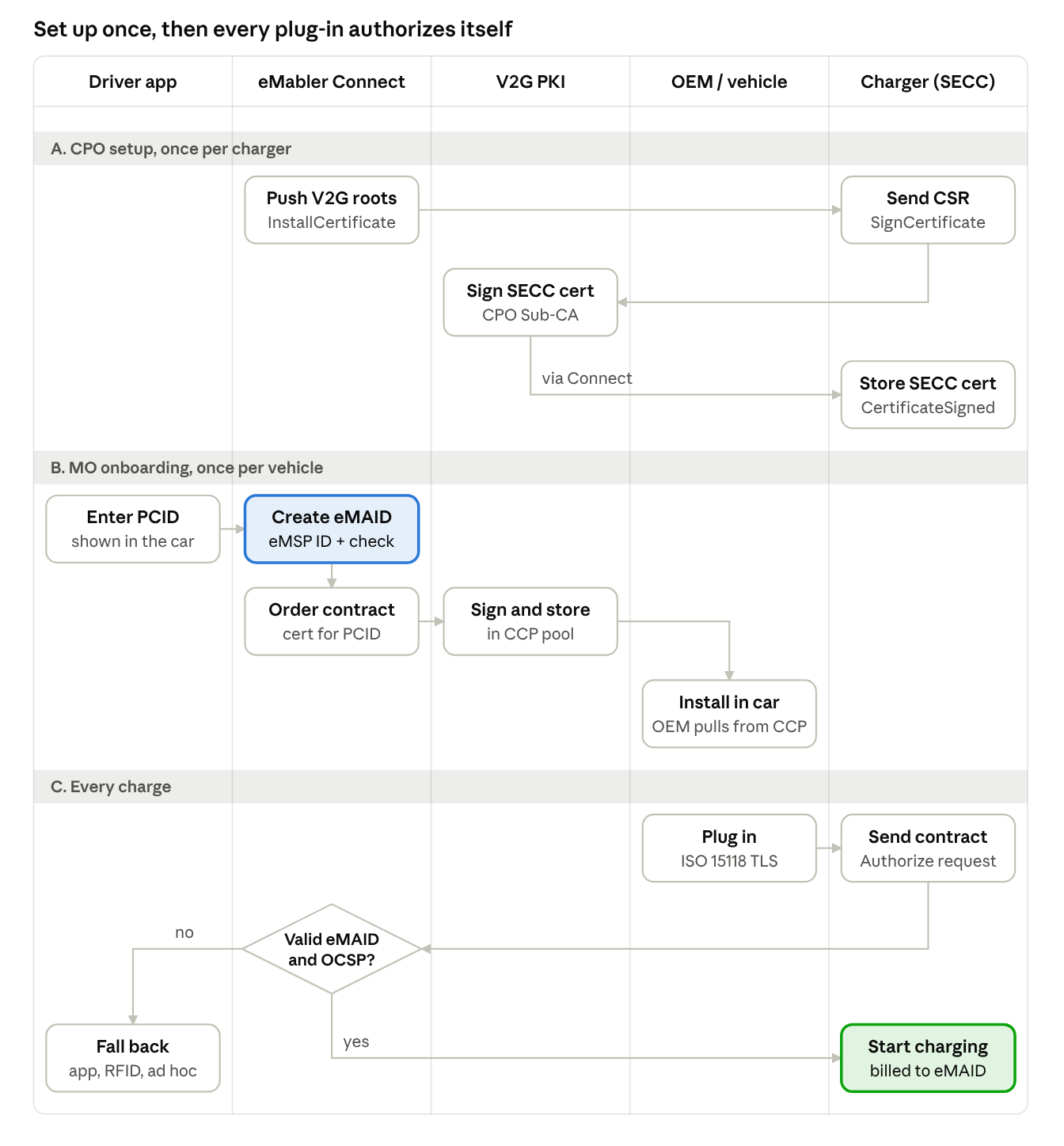
The driver onboards once; after that, every plug-in authorizes automatically. When a foreign MO's driver plugs into your charger, Connect validates their eMAID the same way, via the PKI or OCPI roaming.
Capabilities
|
Capability |
Role |
What it does |
|---|---|---|
|
PnC enablement per charger |
CPO |
Turn PnC on per charger, site or group based on model and firmware |
|
Certificate installation |
CPO |
Push V2G and MO roots; sign SECC certificates from charger CSRs |
|
Expiry monitoring and renewal |
CPO |
Alerts and automatic renewal before certificates expire |
|
OCPP 2.0.1 and 1.6J |
CPO |
Native ISO 15118 messages in 2.0.1; OCA PnC extension in 1.6J |
|
PCID intake |
MO |
App collects the vehicle PCID through Connect APIs |
|
eMAID generation |
MO |
Unique contract IDs under the operator's eMSP ID, with check digit |
|
Contract certificate provisioning |
MO |
Request, track, renew and revoke contracts in the PKI pool |
|
Token and contract linking |
Both |
eMAID works as a token for tariffs, sessions and invoicing |
|
Roaming |
Both |
eMAID tokens and PnC-capable EVSEs exchanged over OCPI |
|
Audit and troubleshooting |
Both |
Certificate history, failed handshakes and reasons per charger and driver |
Why operators choose it
-
Frictionless charging: no app, card or QR at the charger, which lifts session starts and repeat use.
-
Own the driver relationship: operators with an app (ABC, Helen) issue their own contracts instead of relying on OEM or third-party MOs.
-
Open to every PnC driver: CPO networks (Aimo Park, ABC, Helen) accept PnC from any MO trusted in the PKI.
-
No site visits: certificates are installed and renewed remotely from Connect.
-
Same billing as today: the eMAID is just another token, so tariffs, invoicing and reporting stay unchanged.
-
Future-ready: the same certificate foundation supports ISO 15118-20 and bidirectional charging later.
Prerequisites and FAQ
CPO role needs: ISO 15118-capable chargers on OCPP 2.0.1 or 1.6J with the PnC extension, and a CPO Sub-CA agreement with a V2G PKI operator.
MO role needs: an eMSP ID (country + party ID), an MO Sub-CA agreement with a V2G PKI operator(Hubject), and a driver app using Connect APIs.
Which vehicles work? Vehicles whose OEM supports ISO 15118 PnC and is connected to the same PKI ecosystem.
Where does the driver find the PCID? In the vehicle's infotainment or OEM app. The PCID is tied to the car, not the driver.
Can we be CPO and MO at the same time? Yes. Connect runs both roles on one tenant, so your drivers get PnC on your chargers and elsewhere.
What happens if PnC fails at the charger? The session falls back to the usual methods (app, RFID, ad hoc payment), and Connect logs the reason.
Does it work in roaming? Yes. eMAIDs are shared as OCPI tokens, and PnC-capable EVSEs are published in OCPI Locations.