
Summary
Phase rotation tells eMabler DLM which grid phase each charger's L1, L2 and L3 terminal is actually wired to. With it, DLM counts load on the right grid phase, so single-phase EVs spread across the site instead of stacking on one phase, and the site fuse is protected per phase, not just in total.
For operators this means more usable capacity from the same grid connection, fewer fuse trips and fewer throttled sessions at busy sites.
The problem
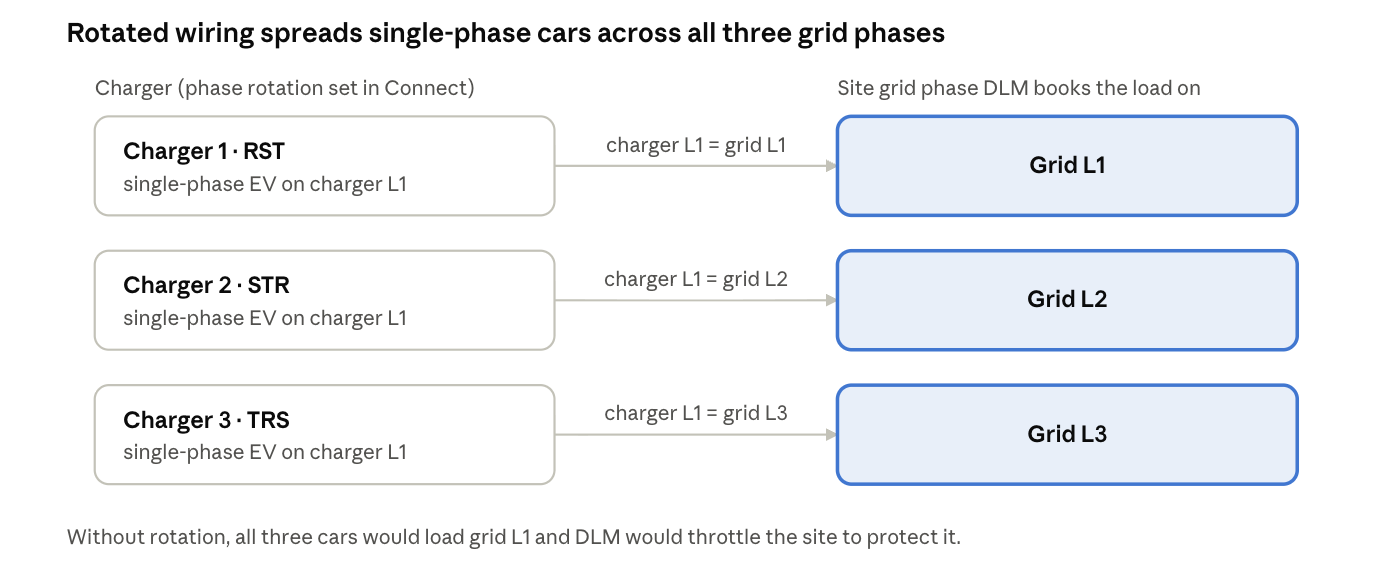
Most EVs on AC charge on one or two phases, and they always draw from the charger's own L1 first. If every charger is wired identically, every single-phase car lands on grid L1.
-
Phase imbalance: grid L1 hits its fuse limit while L2 and L3 sit idle.
-
Wasted capacity: DLM must throttle the whole site to protect L1, even with headroom on the other phases.
-
Wrong accounting: without the mapping, DLM assumes charger L1 = grid L1 and can misjudge which phase is loaded.
Installers fix the imbalance by rotating the wiring per charger (for example charger 1 as L1-L2-L3, charger 2 as L2-L3-L1, charger 3 as L3-L1-L2). The platform then has to know that rotation to use it.
What we have in Connect
Phase rotation is set per socket in Charger → Details → Sockets → Edit socket → Phase rotation. Chargers don't report it, so the installer or operator sets it by hand.
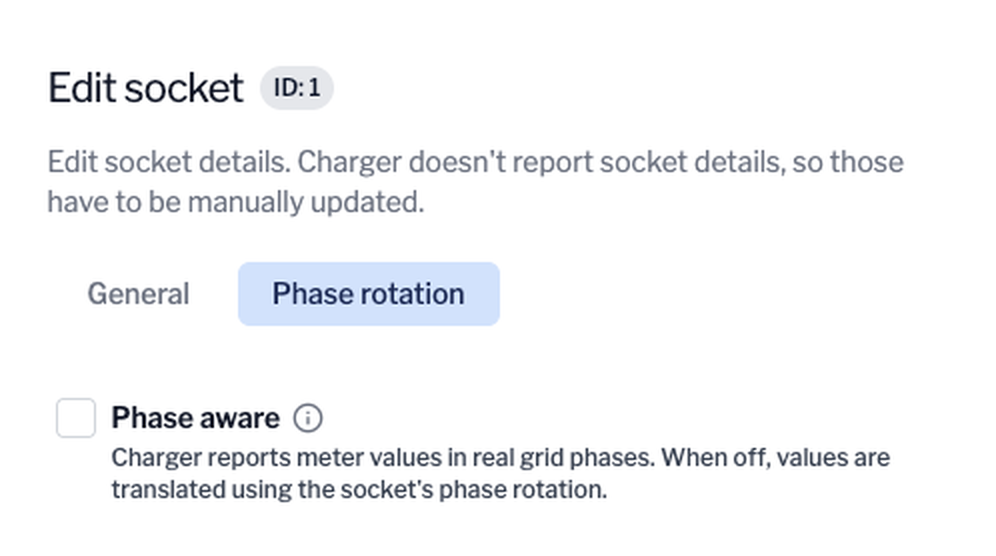
Phase aware is a checkbox. On: the charger already reports meter values in real grid phases, so Connect uses them as-is. Off: Connect translates the charger's meter values into grid phases using the socket's phase rotation.
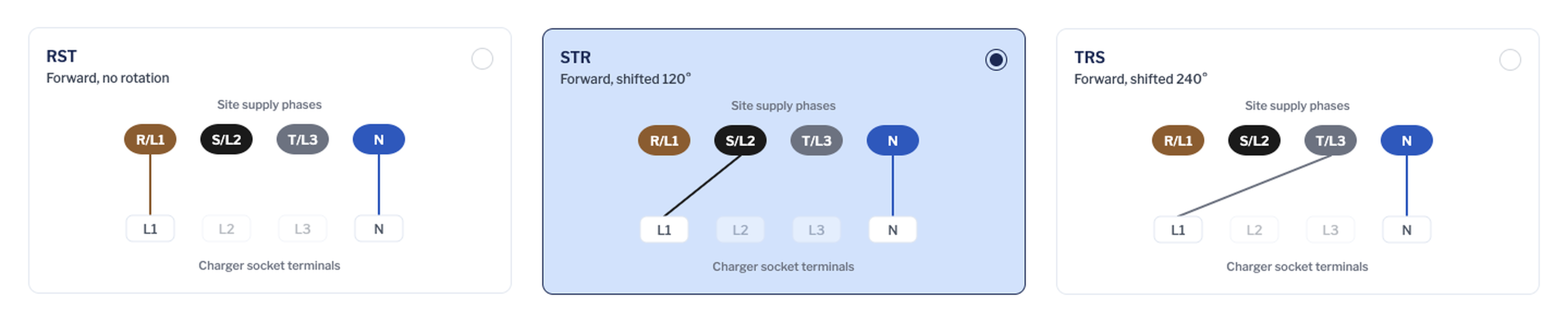
|
Option |
Label in Connect |
Charger L1 → grid |
L2 → grid |
L3 → grid |
|---|---|---|---|---|
|
RST |
Forward, no rotation |
L1 |
L2 |
L3 |
|
STR |
Forward, shifted 120° |
L2 |
L3 |
L1 |
|
TRS |
Forward, shifted 240° |
L3 |
L1 |
L2 |
The power type on the General tab (for example Single-phase AC) tells DLM which terminals draw current. Reverse orders (RTS, SRT, TSR) aren't offered. For EV load, what counts is which grid phase each terminal lands on, not the direction of rotation.
Open questions:
-
The default when no rotation is set (is it RST?).
-
The dialog is labelled TN: how do IT grids (Norway) work?
How it works in DLM
DLM translates every charger's measured or expected current into grid-phase load, then allocates against the per-phase fuse limit.
-
Read load per phase: meter values from each charger (
Current.Importon L1, L2, L3) and from the external meter for non-EV building load. -
Map to the grid: apply each socket's phase rotation, so charger L1 current is booked on the grid phase it is wired to. Phase-aware sockets skip this step.
-
Find headroom per phase: grid fuse limit minus external load minus load margin, calculated for L1, L2 and L3 separately.
-
Allocate: set each charger's limit by the tightest grid phase it actually uses. A single-phase car on a rotated charger only consumes headroom on its own grid phase.
-
Send the profile: push the limit to the charger as an OCPP charging profile, and repeat as load changes.
Open question for engineering: do we allocate strictly per phase today, or on the total with rotation used only for monitoring?
Value for operators
|
Operator type |
What phase rotation gives them |
|---|---|
|
Parking operator, large AC garages |
More chargers on the same fuse; fewer throttled sessions at peak |
|
Utility / CPO with mixed sites |
Accurate per-phase load, so fuse protection holds on older grid connections |
|
Housing companies and workplaces |
Fair charging when most cars are single-phase; no upgrade of the main fuse |
-
Capacity: uses all three phases instead of being capped by the busiest one.
-
Reliability: fewer fuse trips and fewer support tickets from stalled sessions.
-
Grid cost: delays or avoids a larger grid connection.
-
Flex readiness: accurate per-phase headroom is the base for flexibility services on top of DLM.
Setup and limitations
-
Installer wires chargers with rotated phases and records the rotation per charger.
-
Operator sets power type and phase rotation per socket in Edit socket, and ticks Phase aware if the charger already reports grid phases.
-
Operator adds the chargers to a DLM group with the site fuse limit and external meter.
-
Check Live Monitoring: load should show on L1, L2 and L3 as expected.